 |
| Download |
| Arabic: |
 |
French: |
|
| Chinese: |
|
Russian: |
|
| English: |
|
Spanish: |
|
|
 |
A comprehensive knowledge base is available on the United Nations Information Portal on Multilateral Environmental Agreements (InforMEA) to help both new and experienced negotiators to understand and navigate multilateral environmental negotiations and related processes. It includes an interactive version of the newly updated Multilateral Environmental Negotiator's Handbook, training materials, video examples of negotiations, case studies, a collection of rules of procedure and financial rules of various multilateral environmental agreements and the UNEP Glossary of Terms for Negotiators of Multilateral Environmental Agreements.
Click here to view the negotiator's toolkit.
Negotiator's toolkit
A comprehensive knowledge base is available on the United Nations Information Portal on Multilateral Environmental Agreements (InforMEA) to help both new and experienced negotiators to understand and navigate multilateral environmental negotiations and related processes. It includes an interactive version of the newly updated Multilateral Environmental Negotiator's Handbook, training materials, video examples of negotiations, case studies, a collection of rules of procedure and financial rules of various multilateral environmental agreements and the UNEP Glossary of Terms for Negotiators of Multilateral Environmental Agreements.
Click here to view the negotiator's toolkit.
|
 |
| Download |
| English: |
|
Compilation of information, best practices and lessons learned on measures taken by key stakeholders to prevent and reduce single use plastic waste and packaging waste
This compilation has been approved by the working group of the Plastic Waste Partnership of the Basel Convention. It is intended to assist Parties to the Basel Convention, authorities, stakeholders, and the public in the environmentally sound management of plastic wastes. It does not necessarily represent the viewpoints of the working group members on all the details of its content. This compilation should not be understood as derogating from the text of the Basel Convention or any decision(s) adopted by the Conference of the Parties and is without prejudice to the views of individual Parties. The information presented therein is current at the time of writing. The working group reserves the right to revise this content at any given time.
| Download |
| English: |
|
|
 |
| Download |
| English: |
|
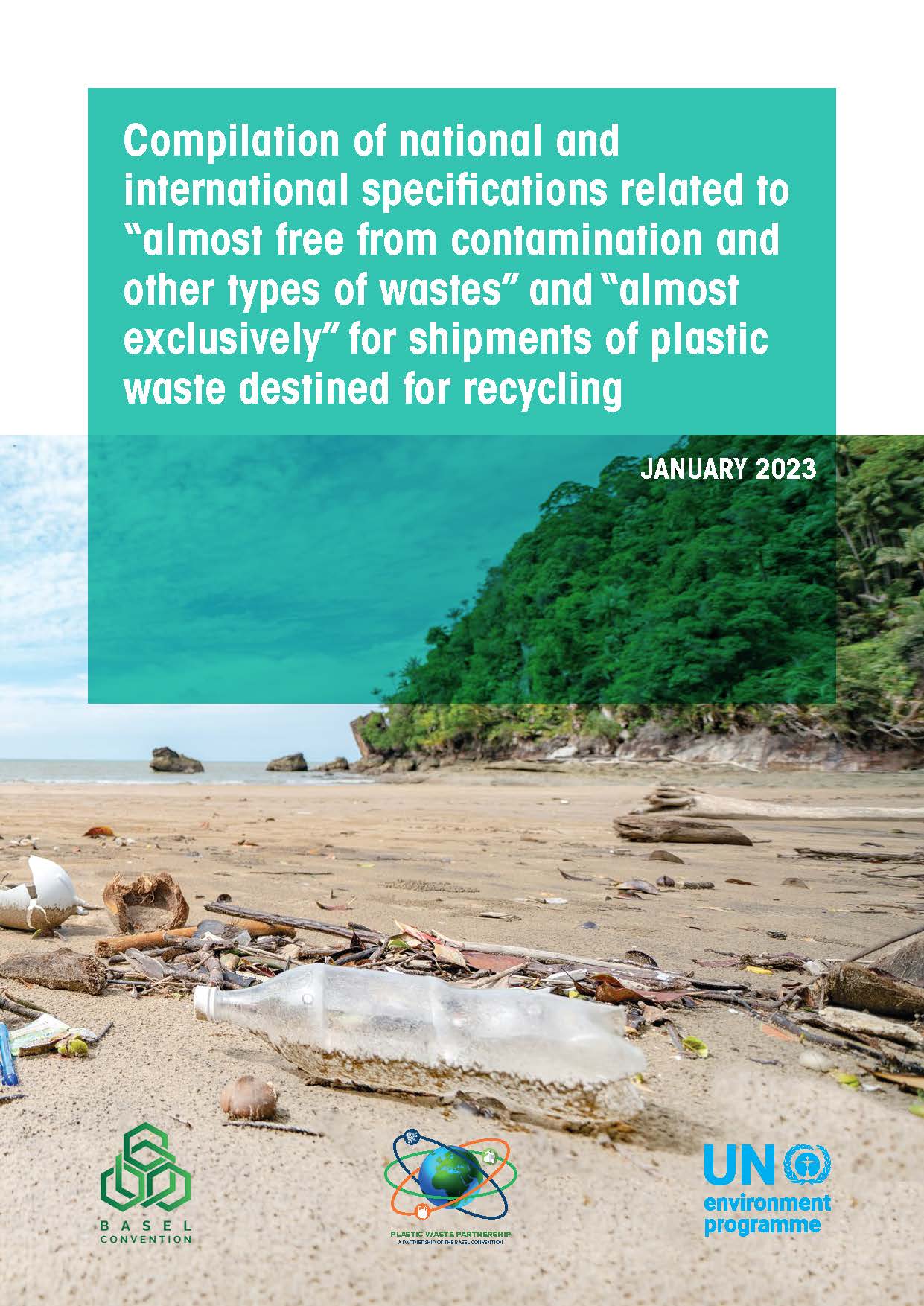
Compilation of national and international specifications related to “almost free from contamination and other types of wastes” and “almost exclusively” for shipments of plastic waste destined for recycling
This compilation has been approved by the working group of the Plastic Waste Partnership of the Basel Convention. It is intended to assist Parties to the Basel Convention, authorities, stakeholders, and the public in the environmentally sound management of plastic wastes. It does not necessarily represent the viewpoints of the working group members on all the details of its content. This compilation should not be understood as derogating from the text of the Basel Convention or any decision(s) adopted by the Conference of the Parties and is without prejudice to the views of individual Parties. The information presented therein is current at the time of writing. The working group reserves the right to revise this content at any given time.
| Download |
| English: |
|
|
 |
| Download |
| English: |
|
Study on the interlinkages between the chemicals and waste multilateral environmental agreements and biodiversity
At the 2002 World Summit on Sustainable Development (WSSD) governments agreed to “achieve, by 2020, that chemicals are used and produced in ways that lead to the minimization of significant adverse effects on human health and the environment […].”.
The Basel, Rotterdam, Stockholm and Minamata conventions contribute to this goal through their specific and individual legal mandates. In addition, the non-binding Strategic Approach to International Chemicals Management (SAICM), has also aimed at the 2020 goal by focusing on important chemicals and waste issues not covered by the above multilateral environmental agreements (MEAs), and is currently in the process of considering its beyond-2020 objectives, structure and targets. The United Nations Environment Assembly (UNEA), which is the governing body of the United Nations Environment Programme (UNEP), also provides leadership on chemicals issues and the interlinkages with other areas of UNEA and UNEP endeavours, such as biological diversity.
| Download |
| English: |
|
|
 |
The “Multilateral Environmental Agreement Negotiator’s Handbook” is a joint publication of Environment Canada and the University of Joensuu – United Nations Environment Programme Course on International Environmental Law-making and Diplomacy.
It is intended to be a solid introduction to and reference tool for negotiating and working on multilateral environmental agreements.
| Download |
| English: |
|
French: |
|
Multilateral Environmental Agreement Negotiator’s Handbook
The “Multilateral Environmental Agreement Negotiator’s Handbook” is a joint publication of Environment Canada and the University of Joensuu – United Nations Environment Programme Course on International Environmental Law-making and Diplomacy.
It is intended to be a solid introduction to and reference tool for negotiating and working on multilateral environmental agreements.
| Download |
| English: |
|
French: |
|
|
 |
The “Training Manual for Chairs of Meetings of the Basel, Rotterdam and Stockholm
Conventions” was developed by the United Nations University Institute of
Advanced Studies on Sustainability (UNU-IAS) in cooperation with the Secretariats
of the Basel, Rotterdam and Stockholm Conventions, within the framework of the
training programme for potential Chairs and Presidents of the Basel, Rotterdam and
Stockholm Conventions’ meetings.
| Download |
English
|
 |
Training Manual for Chairs of Meetings of the Basel, Rotterdam and Stockholm Conventions
The “Training Manual for Chairs of Meetings of the Basel, Rotterdam and Stockholm
Conventions” was developed by the United Nations University Institute of
Advanced Studies on Sustainability (UNU-IAS) in cooperation with the Secretariats
of the Basel, Rotterdam and Stockholm Conventions, within the framework of the
training programme for potential Chairs and Presidents of the Basel, Rotterdam and
Stockholm Conventions’ meetings.
| Download |
English
|
|
|
 |
The main objective of the study is to map the global governance of plastics and associated chemicals,
identify governance gaps, and identify complementarities with existing multilateral instruments
in particular the Basel, Rotterdam and Stockholm (BRS) conventions, in the context of ongoing
intergovernmental efforts to end plastic pollution. In addition, the study discusses the role of
international sustainability criteria for plastics and associated chemicals.
| Download |
English
|
|
Global governance of plastics and associated chemicals
The main objective of the study is to map the global governance of plastics and associated chemicals,
identify governance gaps, and identify complementarities with existing multilateral instruments
in particular the Basel, Rotterdam and Stockholm (BRS) conventions, in the context of ongoing
intergovernmental efforts to end plastic pollution. In addition, the study discusses the role of
international sustainability criteria for plastics and associated chemicals.
| Download |
English
|
|
|
 |
This report examines the relevance of the conventions in response to the environmental and health
emergencies, including the COVID-19 pandemic, and the lessons learnt. The report describes how the
conventions are relevant to support Parties in their work on preventing, preparing for, responding to, and
recovering from emergencies.
| Download |
English
|
|
Environmental and Health Emergencies - The role of the BRS
This report examines the relevance of the conventions in response to the environmental and health
emergencies, including the COVID-19 pandemic, and the lessons learnt. The report describes how the
conventions are relevant to support Parties in their work on preventing, preparing for, responding to, and
recovering from emergencies.
| Download |
English
|
|
|
 |
This document outlines the role of BRS conventions in global governance of chemicals and waste, identifies
possible synergies between existing mechanisms of the BRS conventions and a future science-policy
panel, and – drawing on the experience of these conventions – offers some suggestions for stakeholders
to consider as they plan a new science policy panel to contribute further to the sound management of
chemicals and waste and prevent pollution.
| Download |
English
|
|
From Science to Action
This document outlines the role of BRS conventions in global governance of chemicals and waste, identifies
possible synergies between existing mechanisms of the BRS conventions and a future science-policy
panel, and – drawing on the experience of these conventions – offers some suggestions for stakeholders
to consider as they plan a new science policy panel to contribute further to the sound management of
chemicals and waste and prevent pollution.
| Download |
English
|
|
|
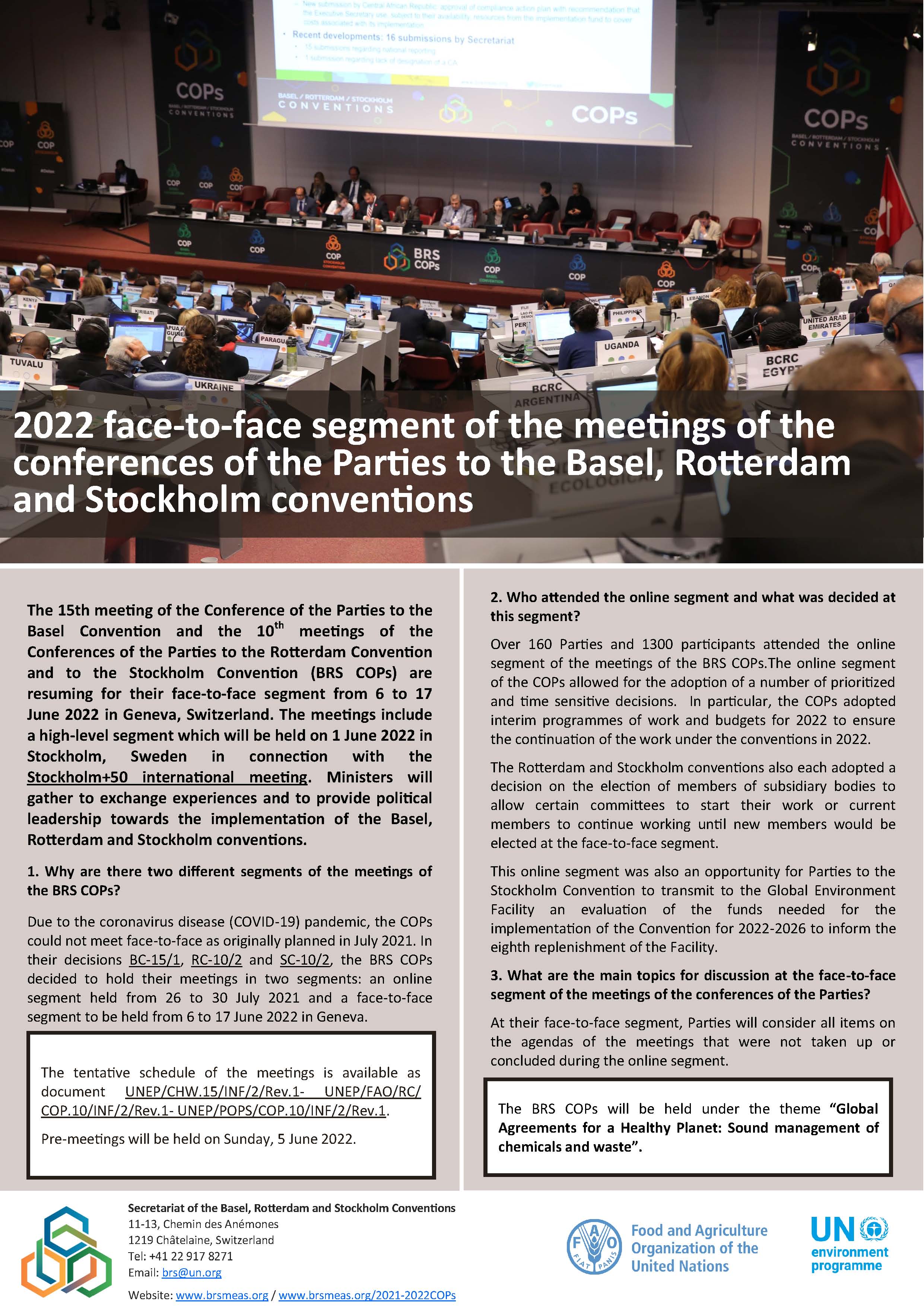 |
The 15th meeting of the Conference of the Parties to the Basel Convention and the 10th meetings of the Conferences of the Parties to the Rotterdam Convention and to the Stockholm Convention (BRS COPs) are resuming for their face-to-face segment from 6 to 17 June 2022 in Geneva, Switzerland. The meetings include a high-level segment which will be held on 1 June 2022 in Stockholm, Sweden in connection with the Stockholm+50 international meeting. Ministers will gather to exchange experiences and to provide political leadership towards the implementation of the Basel, Rotterdam and Stockholm conventions.
| Download |
English
|
|
2022 face-to-face segment of the meetings of the conferences of the Parties to the Basel, Rotterdam and Stockholm conventions
The 15th meeting of the Conference of the Parties to the Basel Convention and the 10th meetings of the Conferences of the Parties to the Rotterdam Convention and to the Stockholm Convention (BRS COPs) are resuming for their face-to-face segment from 6 to 17 June 2022 in Geneva, Switzerland. The meetings include a high-level segment which will be held on 1 June 2022 in Stockholm, Sweden in connection with the Stockholm+50 international meeting. Ministers will gather to exchange experiences and to provide political leadership towards the implementation of the Basel, Rotterdam and Stockholm conventions.
| Download |
English
|
|
|
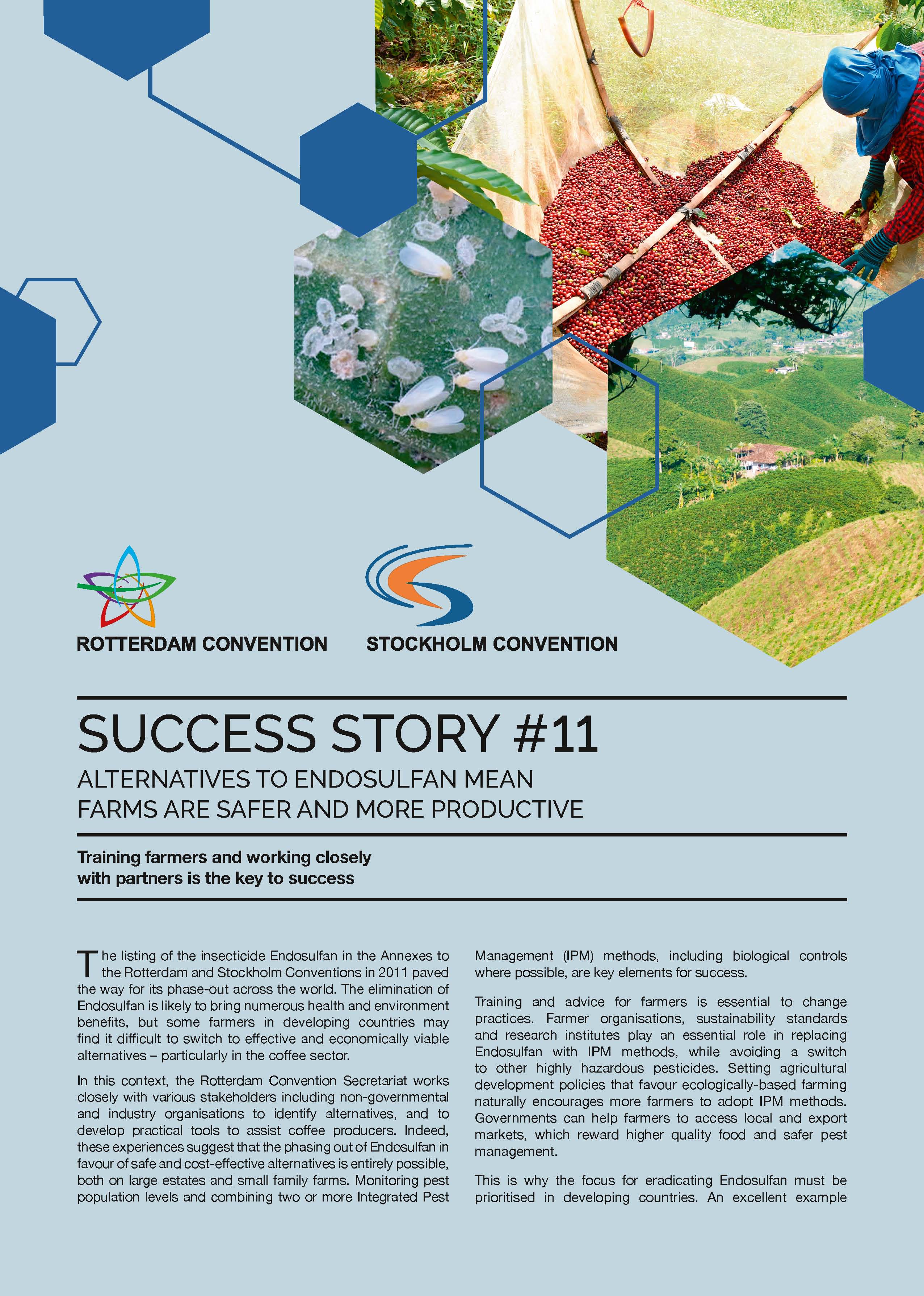 |
Inspirational success stories from the Basel, Rotterdam and Stockholm Conventions
|
 |
| Download |
| English: |
|
Interlinkages between the chemicals and waste multilateral environmental agreements and biodiversity: Key insights
The 1989 Basel Convention on the Control of Transboundary Movements of Hazardous Wastes and Their
Disposal, the 1998 Rotterdam Convention on the Prior Informed Consent Procedure for certain Hazardous
Chemicals and Pesticides in International Trade, the 2001 Stockholm Convention on Persistent Organic
Pollutants, and the 2013 Minamata Convention on Mercury all aim at protecting human health and the
environment from hazardous chemicals and waste.
| Download |
| English: |
|
|
 |
| Download |
| English: |
|
Chemicals, wastes and climate change - Interlinkages and potential for coordinated action
Climate change and management of hazardous chemicals and wastes are two of the many challenges
facing policy and decision makers committed to meeting the Sustainable Development Goals, as set out in
the 2030 Agenda for Sustainable Development. A number of global agreements have been established to
address these issues. The United Nations Framework Convention on Climate Change seeks to both stabilize
greenhouse gas (GHG) concentrations in the atmosphere and adapt to the eventual inevitable impacts of
climate change. Falling within the scope of this study, hazardous chemicals related agreements include
the Rotterdam Convention on the Prior Informed Consent Procedure for certain Hazardous Chemicals
and Pesticides in International Trade, the Stockholm Convention on Persistent Organic Pollutants (POPs)
and the Minamata Convention on Mercury. Finally, the Basel Convention on the Control of Transboundary
Movements of Hazardous Wastes and Their Disposal focuses specifically on waste-related issues.
| Download |
| English: |
|
|
 |
Factsheets on the newly listed chemicals of the 2017 Conferences of the Parties
| Download |
| English: |
|
Factsheets on the newly listed chemicals of the 2017 Conferences of the Parties
Factsheets on the newly listed chemicals of the 2017 Conferences of the Parties
| Download |
| English: |
|
|
 |
Compilation of decisions related to enhancing
cooperation and coordination among the Basel,
Rotterdam and Stockholm conventions
| Download |
| English: |
|
10 Years of Synergies Decisions 2005 - 2015
Compilation of decisions related to enhancing
cooperation and coordination among the Basel,
Rotterdam and Stockholm conventions
| Download |
| English: |
|
|
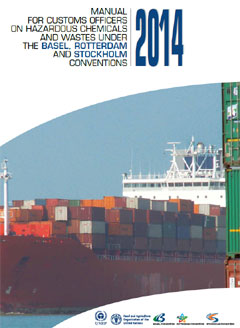 |
The interactive Manual for Customs on hazardous chemicals and wastes under the Basel, Rotterdam and Stockholm conventions will enhance your knowledge of the three global treaties that contribute to safely managing the production, movement, use and disposal of hazardous chemicals and wastes.
| English: |
|
Manual for customs officers
The interactive Manual for Customs on hazardous chemicals and wastes under the Basel, Rotterdam and Stockholm conventions will enhance your knowledge of the three global treaties that contribute to safely managing the production, movement, use and disposal of hazardous chemicals and wastes.
Customs play a key role in facilitating the legal trade of hazardous chemicals and wastes, and in detecting possible cases of illegal traffic – especially in ports and along the borders. This manual will inform you about the objectives, procedures, rights and obligations contained in these three multilateral environmental agreements as they relate to the work of Customs. It describes in general what Customs should know to facilitate the legal trade in hazardous chemicals and wastes. It will also support you in how to identify and deal with possible cases of illegal trade/traffic.
The Manual is divided into 6 modules, each of them containing an introduction, lessons, questions and a resources section. The lessons are supported by practical examples and images.
The Manual is complemented by four annexes:
- a glossary explaining key terms and concepts under the Basel, Rotterdam and Stockholm Conventions which will be frequently referred to in this Manual (annex I);
- an identification tool for wastes covered by the Basel Convention (annex II);
- an identification tool for the persistent organic pollutants that may be subject to international trade under the Stockholm Convention (annex III); and
- an identification table for the chemicals covered by the Rotterdam Convention (annex IV).
The Manual was developed with the support of a financial contribution from the European Union.
| English: |
|
|
 |
International trade control measures under the Basel, Rotterdam and Stockholm Conventions
|
 |
| Download |
| English: |
|
Compilation of decisions related to enhancing cooperation and coordination among the Basel, Rotterdam and Stockholm conventions
| Download |
| English: |
|
|
 |
| Download |
| English: |
|
Training Manual for Chairs of Meetings of the Basel, Rotterdam and Stockholm Conventions
| Download |
| English: |
|
|